"""
Exploring Benford's Law by applying it to the files sizes
on a local hard drive

Note: this is a 'hacky' version that works but is NOT very Pythonic
"""


import os

# The significand ranges from 1 thru 9 inclusive (0 is excluded)

FIRST_DIGIT_PERCENTAGES = [
                            30.1,    ## '1'
                            17.6,
                            12.5,
                             9.7,
                             7.9,
                             6.7,
                             5.8,
                             5.1,
                             4.5     ## '9'
                          ]

# 2nd and subsequent digits range from 0 thru 9 inclusive
# (0 is included)

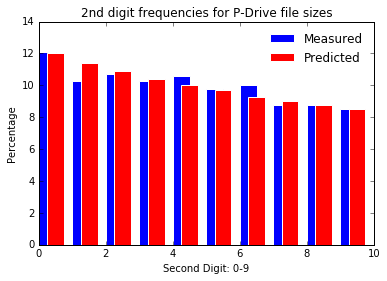
SECOND_DIGIT_PERCENTAGES = [
                             12.0,  ## '0'
                             11.4,
                             10.9,
                             10.4,
                             10.0,
                              9.7,
                              9.3,
                              9.0,
                              8.8,
                              8.5   ## '9'
                            ]


class BenfordDigit(object):
    '''
    Class to test whether given number digits adhere to Benford's Law
    Class Attributes:
      __experiment_name: <string> unique label for each Benford test
      __digit_position:  int>     significand = 1, 2nd digit,
                                  counting from LHS = 2 ...
      __digit_count:     <dict>   tally of numbers encountered in given
                                  digit position
      __current_number:  <int>    most recent number reported in digit
                                  position, used to
                                  increment the corrsponding entry in
                                  digit_count tally
      __number_count:    <int>    sum of all numbers found in a given
                                  digit_position
      __digit_percent:   <list>   list of percentages corresponding to
                                  relative frequencies
                                  for each number for a given
                                  digit_position (1-9 for significand,
                                  or 0-9 otherwise)
    '''

    def __init__(self, experiment_name, digit_position):
        self.__experiment_name = experiment_name
        self.__digit_position = digit_position

        self.__digit_count = {
                    '0': 0,
                    '1': 0,
                    '2': 0,
                    '3': 0,
                    '4': 0,
                    '5': 0,
                    '6': 0,
                    '7': 0,
                    '8': 0,
                    '9': 0
                   }
        self.__current_number = '1'
        self.__number_count = 0

        self.__digit_percent = []

    def __str__(self):
        return ('Experiment: %s   Digit position: %i' % \
                (self.__experiment_name,self.__digit_position))

    def __repr__(self):
        return str(self)

    @property
    def experiment_name(self):
        return (self.__experiment_name)

    @property
    def digit_position(self):
        return (self.__digit_position)

    @property
    def digit_count(self):
        # return [(k,v) for k,v in
        # sorted([(k,v) for k,v in self.__digit_count.items()])]
        return sorted([(k,v) for k,v in self.__digit_count.items()])

    @property
    def current_number(self):
        return self.__current_number

    @current_number.setter
    def current_number(self, number):
        self.__current_number = number
        self.__digit_count[self.__current_number] += 1

    @property
    def number_count (self):
        if self.__digit_position == 1:
            # return all numbers excl. 0's
            return sum(value for key,
                value in self.__digit_count.items() if key != '0')
        else:
            return sum(value for key,
                value in self.__digit_count.items()) ## Simplify!
    @property
    def digit_percent (self):
        self.__digit_percent = []
        if self.__digit_position == 1:
            # return ratio of all numbers excl. 0's
            for i in range(1,10):
                d1 = self.__digit_count[str(i)] / self.number_count
                self.__digit_percent.append(round(100.0*d1, 1))
            return self.__digit_percent
        else:
            # return ratio of all numbers incl. 0's
            for i in range(0,10):
                d2 = self.__digit_count[str(i)] / self.number_count
                self.__digit_percent.append(round(100.0*d2, 1))
            return self.__digit_percent

### Significand
benford1 = BenfordDigit('Local P: Drive Files - Significand', 1)

### 2nd Digit
benford2 = BenfordDigit('Local P: Drive Files - 2nd Digit', 2)

for root, dirs, files in os.walk('P:/'):
    for name in files:
        filename = os.path.join(root, name)
        filesize = os.path.getsize(filename)

        digit1Strng = (str(filesize))[0]
        benford1.current_number = digit1Strng

        if filesize > 9:
            benford2.current_number = str(filesize)[1]

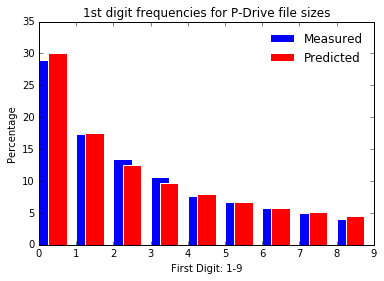
# Plot predicted 1st digits frequencies versus actual

# Show plots in notebook (rather than in separate window)
%matplotlib inline

import numpy as np
import matplotlib.pyplot as plt

X = np.arange(len(benford1.digit_percent))
plt.bar(X + 0.0, benford1.digit_percent, facecolor='blue',
        edgecolor='white', width=0.5, label="Measured")
plt.bar(X + 0.25, FIRST_DIGIT_PERCENTAGES, facecolor='red',
        edgecolor='white', width=0.5, label="Predicted")

plt.title('1st digit frequencies for P-Drive file sizes')
plt.xlabel('First Digit: 1-9')
plt.ylabel('Percentage')
plt.legend(loc='upper right', frameon=False)

plt.show()

print ('\nPredicted 1st Digit Ratios:\n\t',
       FIRST_DIGIT_PERCENTAGES)
print ('Observed 1st Digit Ratios:\n\t',
       benford1.digit_percent, '\n')